 My Little Shop
The complete guide
How to run a pretend shop
Somewhere in your house right now there is a shopkeeper waiting for their shop. This is the full setup - from the sign on the door to the cha-ching of the till - built from free printables, a box of toys, and one small app that ties the whole thing together. Budget an afternoon. Expect to be charged for your own biscuits by dinner time.
1. Pick your shop 🏪
Every great pretend shop starts with one big decision: what do we sell? There are no wrong answers, but there are excellent ones:
- The toy shop - the classic. Teddies, dinosaurs, blocks and cars are already on the floor; you're halfway there.
- The pretend grocery store - raid the pantry for tins, cereal boxes and the good pasta. Real packaging makes it feel serious.
- The cafe - play food, a notepad for orders, and a strong opinion about babyccinos.
- The book shop - every picture book gets a price, and story time is a paid extra.
- The vet clinic - technically a service business, but sick teddies pay their bills like anyone else.
In the My Little Shop app, this is the first choice too: build a shop, cafe or restaurant, name it, and pick its picture. The Sunshine Café and The Toy Store were both founded by five year olds.
2. Make it official: the open sign 🪧
A shop is not a shop until it can be closed. Print the free open and closed sign, thread the string, and hang it on a door handle or the back of a chair. OPEN on one side, CLOSED on the other.
Flipping that sign is the ceremony that starts and ends every trading day, and small shopkeepers take their trading hours extremely seriously. The shop opens when the shopkeeper says so, and not a minute before.
3. Stock the shelves 🧸
Anything can be stock. The trick is treating it like stock: arranged in rows, facing forward, looking like it wants to be bought.
- Teddies and dolls sit in a row along the couch - the premium shelf.
- Dinosaurs get sorted by ferocity. The T-rex costs more. Everyone accepts this.
- Pantry tins and boxes stack into a proper grocery aisle - this is where the grocery printables below earn their keep.
- Play food becomes the cafe cabinet - plastic croissants have never looked so profitable.
- Drawings are fine art, and fine art is expensive.
In the app, the shelves work the same way: pick what the shop sells from hundreds of colourful pictures, write little descriptions, and arrange the register just so.
4. Put a price on everything 💲
Pricing is where the maths sneaks in. Print the free price tags - six write-your-own shelf tags with fold-over flaps, plus SALE stickers for slow-moving stock.
Let the shopkeeper set every price themselves. Whole dollars for little ones; sneaky fifty cents for bigger kids who are ready to count harder change. A $4 dinosaur and a $6.50 teddy is a two-item basket that quietly teaches addition.
The app prints its own price tags too - with the shop's real items and real prices on them, sale stickers included.
5. Print the money 💵
No shop survives without cash flow. Print the free play money - notes and coins to cut out, share between shopkeeper and customers, and count with great ceremony.
Even better: print it in your money. The app plays in sixteen currencies, and there are free printable sheets to match - Australian dollars, US dollars, pounds, euros and more - so the change your child counts is the change in your pocket. The app goes one further and prints money branded with the shop's own name.
6. The barcodes (this is where it gets magic) 🏷️
Here is the part no amount of paper can do alone. The My Little Shop app prints barcode stickers that really scan. Stick one on the teddy, one on the dinosaur, one on the tin of beans - then point the phone's camera at any of them and the till beeps and rings it up, exactly like the supermarket checkout.
The first time a sticker scans, most kids go very quiet, then very loud. The queue of toys forms itself after that.
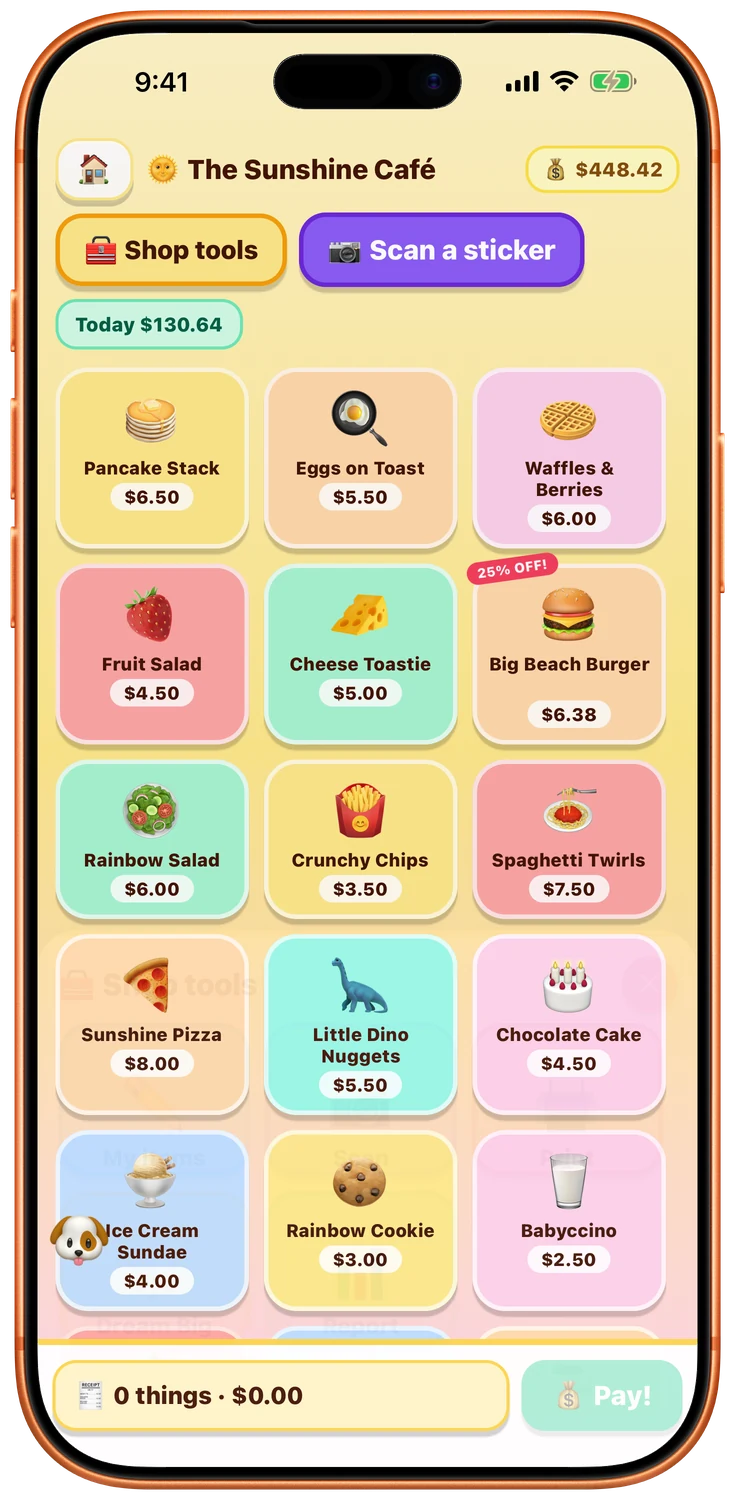
The till keeps a running total, takes the customer's money, counts the change out in front of them, then celebrates the sale with a cha-ching. The takings go into the shop's bank, where they can fund a shop puppy, new shelf pictures, a golden shopfront and other optional shop upgrades.
7. Cafe day: menus, orders and table service 📋
When the shop becomes a cafe, the paperwork changes. Print the free fill-in menu and let the chef write breakfast, lunch and dinner in their own hand - prices in the circles, invented dishes encouraged.
In the app, the restaurant runs properly: book the tables, seat the teddies, take each table's order with special notes ("no veges please!"), and print fold-up table signs so table three knows it is table three. Dinner service at a busy pretend restaurant is genuinely hectic, in the best way.
8. Have a sale 🎉
Nothing moves stock like a big red SALE poster - the app prints those - and nothing teaches subtraction like marking the $6.00 rainbow salad down to $4.50. Announce it loudly. Reprice everything. Watch the rush.
9. Bags, packets and takeaway 🛍️
Every purchase deserves packaging. Fold the free paper shopping bag with its string handles for the big spenders, and the fries-carton chip packet for the takeaway crowd - fill it with paper chips and charge $3.50, as is tradition. The app adds fold-up packets for anything the shop sells, plus real-looking receipts and name badges, because you work here now.
10. Closing time 🌙
Flip the sign to CLOSED. Count the takings. In the app, the day ends with a proper little sales report - what sold, what it made, and a bar chart a six year old reads at a glance. The Awards page remembers goals they have reached and shows what to try next, while the bank balance creeps towards whichever shop upgrade they have chosen.
Then tomorrow, the sign flips back, and the whole economy starts again.
The shopkeeper's shopping list ✂️
Free printables: open sign · price tags · play money · cafe menu · shopping bag · chip packet
And one app to run the till, scan the barcodes and print the rest - free, with no ads and nothing collected.
That page was one sheet. Here comes the whole shop.
The app prints all of this, with your child's shop name on it
Everything below comes out of your ordinary printer, made from your child's actual shop - their name on the money, their prices on the tags, their menu in their handwriting-sized letters. Stick a barcode sticker on a teddy, point the camera at it, and it beeps and rings up on their own till, exactly like the supermarket. That moment is the whole app in one go.
The download is free, with no ads and no accounts - your first shop, the whole cash-and-card till, Awards, Team up, sticker scanning, and printable money, bank cards, barcodes and product packets cost nothing. One optional unlock opens every printable above, restaurant tables, unlimited shops and the full sales history.
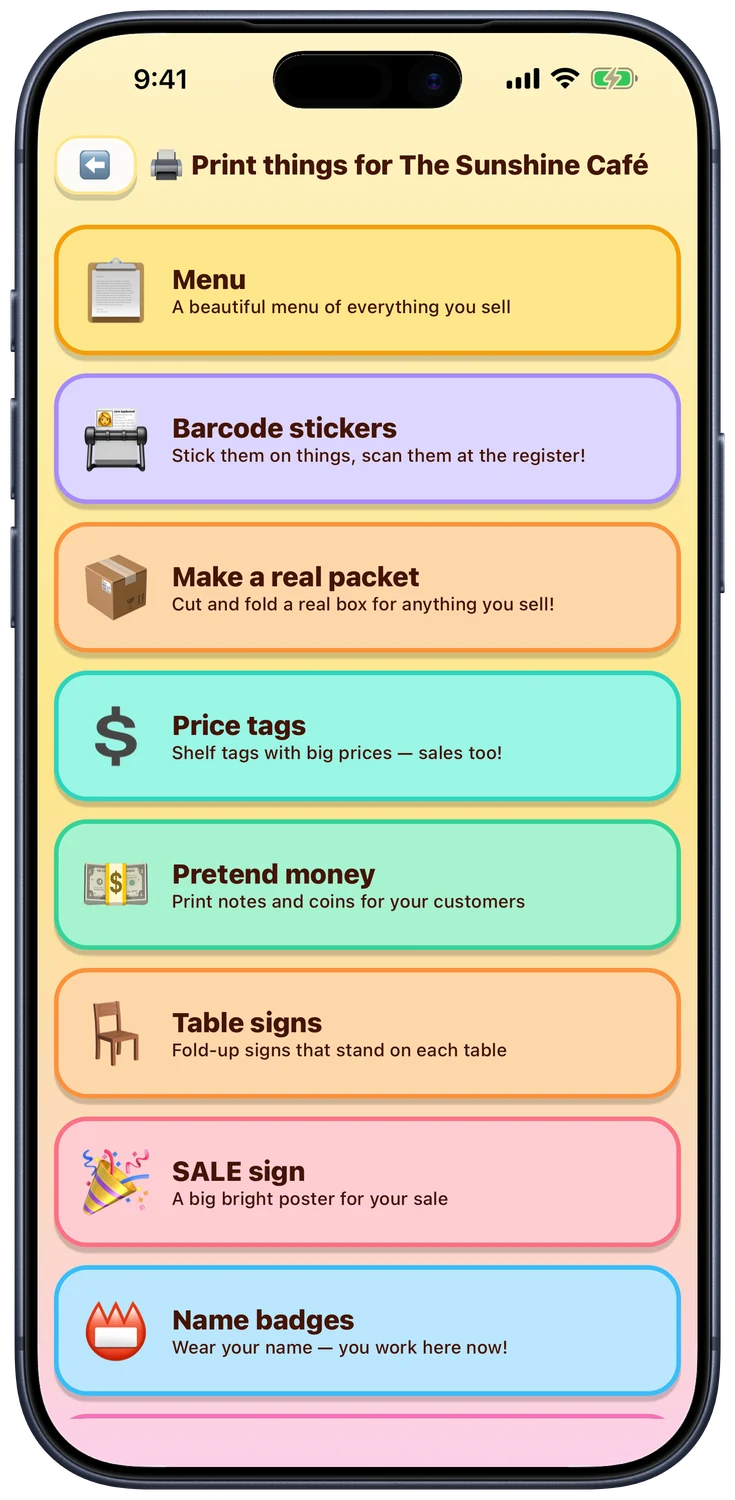 The print screen, in the real app